
The Trust Fall is Dead: Why Real Adventure is the Ultimate Team Glue
We have all been trapped in that exact same room at some point in our working lives. The fluorescent lights hum a bit too loudly overhead, the lukewarm coffee is slowly pooling in the bottom of a paper cup, and a well-meaning facilitator instructs you to close your eyes, stiffen your spine, and tip backward into the arms of a coworker you have only ever spoken to via a brief, polite Slack message.
The corporate trust fall has become the ultimate workplace cliché for a very simple reason: it feels completely manufactured, because it is. True trust isn’t something you can summon on command in a windowless conference room while everyone awkwardly avoids eye contact and prays they don’t drop the Head of Finance. It is something that is forged organically when you are laughing so hard your ribs hurt, stepping just a little bit outside of your usual comfort zone, and figuring things out together in the fresh air.
If you genuinely want to understand how your team functions when the corporate armor comes off, you have to get them away from their desks and throw a little adventure their way. When you swap spreadsheets for blue skies, the entire dynamic of a workplace shifts in ways that a PowerPoint presentation on “company culture” could never hope to achieve. Here is a deeper look at why stepping outside changes everything, and how a bit of genuine play can solve your biggest organizational hurdles.
Stripping Away the Titles (and the Ties)
In any standard office environment, hierarchy is a silent but incredibly loud presence. The Vice President sits at one end of the long mahogany table, the senior managers occupy the middle ground, and the new intern sits quietly at the far end, carefully calculating every word before they dare to speak. People naturally filter their thoughts, censor their ideas, and modify their personalities based entirely on who else is in the room. It is exhausting, and it is a massive barrier to real collaboration.
But here is the beautiful thing about the great outdoors: gravity does not care about your job title.
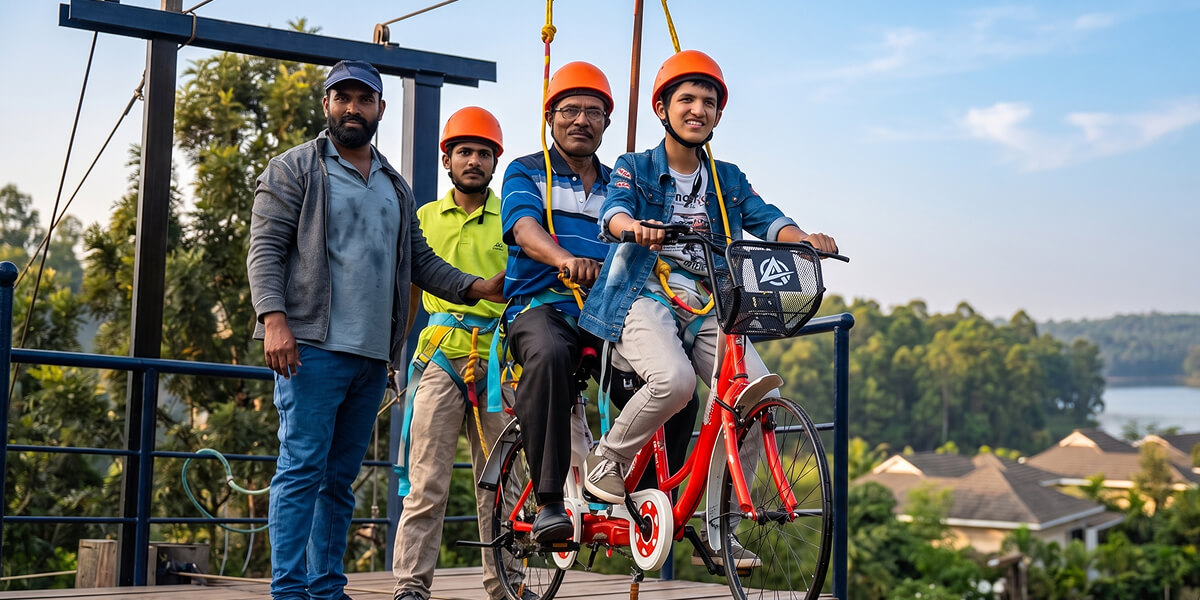
When a team tackles a High Rope Course suspended several feet in the air, or attempts to navigate the tricky, uneven rungs of a Russian Ladder, the corporate structure completely evaporates. The brilliant manager who can orchestrate a multi-million-dollar quarterly projection with their eyes closed might find themselves completely terrified of taking that very first step onto a swaying wooden plank. Meanwhile, the quietest junior developer—the one who rarely speaks up in brainstorming sessions—steps up naturally to cheer them on, offering a steady hand, an encouraging word, or a piece of practical advice on where to place their foot next.
Suddenly, everyone is reduced to the exact same status: human beings trying to get from point A to point B without looking entirely ridiculous. This radical leveling of the playing field breaks down deep-seated barriers faster than a dozen formal feedback sessions ever could. It serves as a gentle, necessary reminder that underneath the emails, the KPIs, and the professional jargon, we are all just regular people navigating obstacles. When you return to the office on Monday, that invisible wall between departments is gone, replaced by a mutual understanding that you all survived the same swaying bridge.
The Magic of Shared Vulnerability
In the modern workplace, we talk a lot about psychological safety—that golden corporate state where employees feel comfortable speaking up, pitching wild ideas, admitting mistakes, or asking for help without the fear of being judged or penalized. It sounds wonderful on paper, but building that kind of safety in a high-stress environment is incredibly difficult. People naturally want to protect their images; they want to look flawless, competent, and entirely in control at all times.
Adventure activities act as a massive, high-speed accelerator for psychological safety because they require a tiny, controlled dose of vulnerability.
Taking on a physical challenge like Wall Climbing or Rappelling involves a conscious, personal choice to step out of what is safe and comfortable. It is a moment where you have to accept that you might wobble, you might look a bit uncoordinated, and you might even have to yell, “Hey, I’m stuck, what do I do now?” to the person holding the rope below. When your team sees you try, struggle, and maybe even fail a couple of times before finally reaching the top, a profound shift occurs in the group dynamic. You gain a massive amount of genuine human connection.
When teams experience those raw, unfiltered, completely unpolished moments together, they subconsciously carry that exact same comfort back to the office. The next time a project starts veering off track, or a tight deadline requires someone to put up their hand and say, “I am drowning over here and I need help,” it becomes infinitely easier to do. Why? Because they have already shown their vulnerable side outside of work, and the world didn’t end. In fact, their team caught them.
Communication Without the Corporate Speak
Think about the way a typical team solves a problem in the office. It almost always involves scheduling a thirty-minute meeting, drafting an agenda, typing notes in a shared document, and using a lot of safe, carefully sanitized phrases like “let’s circle back,” “synergy,” and “moving the needle.” It is a slow dance where people often say what they think others want to hear rather than what actually needs to be said.
Now, contrast that with a team trying to navigate a Low Rope Course where every single step requires absolute physical coordination, or a group trying to keep their balance inside a giant, inflatable Water Roller or Land Zorb. There is absolutely no room for low-hanging fruit or touching base when you are literally rolling head-over-heels across a grassy field or trying to figure out how to pass a teammate a rope without everyone falling over.
Adventure forces immediate, crystal-clear, and brutally honest communication. It teaches teams how to read each other’s frantic body language, how to give precise instructions under a bit of pressure, and most importantly, how to listen to one another without letting ego get in the way. You learn who panics, who takes charge, who listens quietly, and who finds a creative loophole to solve the puzzle. It turns out that the best way to improve a team’s communication flow isn’t to give them a lecture on internal memos; it’s to give them a physical puzzle that they can only solve by talking like real human beings.
Finding Joy in the Absolute Mayhem
Perhaps the most wildly underrated benefit of a team adventure day is the pure, unadulterated therapeutic power of fun. Somewhere along the line of transitioning from childhood to adulthood, we forgot how to just play. We spend forty to fifty hours a week being intensely serious, hitting aggressive targets, managing tight budgets, and managing professional optics. Sharing a moment of absolute, total absurdity is the ultimate pressure valve for a stressed-out workforce.
Have you ever looked your department head dead in the eye while you are both wearing massive, inflatable plastic bubbles, right before you sprint across a field and send them flying into a soft, bouncy heap? Activities like Bubble Soccer, or trying to duck, dive, and dodge a sweeping, rotating padded arm on a Melt Down platform, do not require strategic mastery, an advanced degree, or a flawless pedigree. They require only one thing: a complete willingness to look entirely ridiculous and laugh until your stomach hurts.
That kind of shared, breathless laughter is a powerful shock absorber for future workplace stress. When a high-stakes client presentation inevitably gets tense three months down the line, or an unexpected software bug crashes the system right before launch, the mood can be instantly broken by a quick, dry reference to the day the entire marketing team got wiped out by a giant inflatable arm. It grounds the team, cuts through the panic, and reminds everyone that whatever happens, they are in it together.
Leaving the Comfort Zone (and Liking It)
A team that only stays within its established comfort zone will eventually, inevitably stagnate. Innovation doesn’t happen when people do exactly what they have always done, in the exact same ways they have always done it. By introducing elements of controlled adventure into a team’s routine, whether it is the sudden, heart-in-your-throat rush of a Rocket Ejector or the steady, quiet focus required for Archery or Bottle Shooting, you introduce your team to the wonderful feeling of overcoming a challenge as a collective unit.
The goal of a great team outing isn’t to transform your entire office into a group of hardcore, extreme sports athletes who spend their weekends jumping out of planes. The goal is much simpler and much deeper than that. It is to remind every single person what it feels like to explore, to laugh freely, to support one another without an agenda, and to return to their desks on Monday morning with a slightly different perspective.
When you look across the room or scroll through your video call tiles next week, you won’t just see a collection of job descriptions and email signatures. You will see the person who cheered you on when you were stuck on the climbing wall, the person who made you laugh until you cried in a giant zorb ball, and the team that is fully ready to catch you whenever you take a leap.

I visited this resort with my family for a stay of two nights. Overall a great experience for my kids to remember. The entire staff including the reception, food section as well as at the activities are very polite. Swapan was especially very friendly. Wave pool is the highlight of this resort and the kids enjoyed it to the core. Food was decent (Evening snacks were very good). They have a standard menu for food so if you stay more than a day many items seem to repeat but they are made fresh for sure. Thank you Shashi who helped me with booking and the entire staff for leaving such a great memory for us.

Yesterday we had been to this resort it was amazing day filled with enjoyment, adventures and lots of delicious food. Resort is well maintained, pool is very big with waves it was totally worth it. And about the staff, every staff member is very humble and at service every time. The adventure game staff members are very supportive, encouraging and all the adventure games were very much adventurous had a lot of fun. Thank you Odyssey Retreat Resort we had fun filled day.

We visited Odyssey Retreat with a group of 25+ members from our community, and the experience was absolutely fantastic! The adventure games were a huge hit with everyone, from kids to adults. There was something for every age group to enjoy. The food was simply fabulous! They had multiple varieties that catered to everyone, and the taste was superb. The location is a hidden gem. It felt like a beautiful hill station, yet it’s hardly a 1-hour drive from Bangalore—the perfect distance for a quick getaway. We left feeling completely rejuvenated from our routine city life. Highly recommended for large groups and families!

Had a wonderful stay at The Odyssey Retreat Resort. The entire property is beautifully maintained with lush greenery all around, creating a calm and relaxing atmosphere that makes it perfect for a peaceful getaway. The rooms are very clean and cozy. We stayed in the Bamboo Cottage, which was spacious, well-kept, and extremely comfortable. The food deserves a special mention — a solid 5 stars! The chicken curry prepared by Chef Sham Sundhar was absolutely delicious and one of the highlights of our stay. Overall, it was a very pleasant stay. Highly recommended for anyone looking for a serene and well-maintained retreat.

We had an amazing experience at the resort! The environment is beautiful and peaceful, making it a perfect place to relax. The food was absolutely excellent — every meal was delicious and well-prepared. The staff were very kind, friendly, and always ready to help. Our room was clean, comfortable, and well-maintained. A special thank you to Anusha and Nandhan, who is in charge of the shooting game, for making our stay even more enjoyable. And heartfelt thanks to the chef for the wonderful food! We truly appreciate the warm hospitality and had a fantastic time.